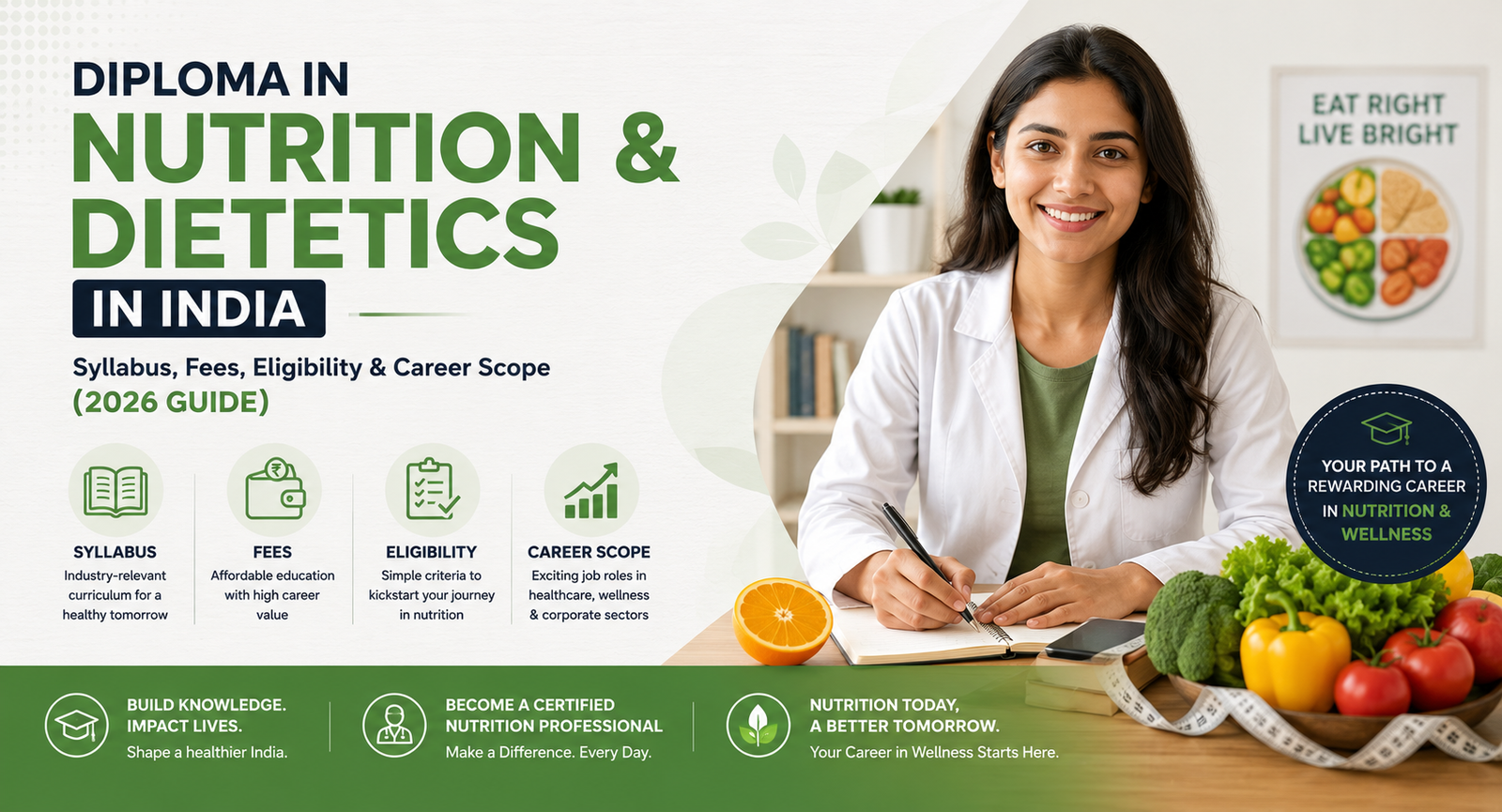
Diploma in Nutrition and Dietetics in India: Syllabus, Fees, Eligibility & Career Scope (2026 Guide)
By Dt. Deepika Bengani | Founder, Nufit Redefined | Clinical Dietitian, Delhi | Last updated: July 2026
If you search for “diploma in nutrition and dietetics in India,” most of what you find was written by content aggregators who have never designed a nutrition curriculum or counselled a single patient. College directories list programs by city. Ranking sites compare entrance exams. Nobody writes from the inside.
This guide is different. Dt. Deepika Bengani founded Nufit Redefined and designed its diploma curriculum. Every section below answers questions she actually gets from prospective students — before enrolment, at orientation, and during the program. If you are deciding whether a diploma in nutrition and dietetics is the right next step, this is the guide you need to read first.
What Is a Diploma in Nutrition and Dietetics?
A diploma in nutrition and dietetics is a structured professional qualification that trains you to assess dietary intake, identify nutritional deficiencies, design therapeutic diet plans, and counsel individuals on evidence-based nutrition for health and disease management.
It occupies a specific space in the Indian nutrition education landscape:
- Short certificate course (1–3 months): Theory introduction only. No clinical component. Not adequate for independent client practice.
- Diploma in nutrition and dietetics (6–12 months): Covers clinical dietetics, medical nutrition therapy, case work, and assessment skills. The minimum credible qualification for building an independent practice or moving into a clinical support role.
- B.Sc. / M.Sc. in Food Science, Home Science, or Dietetics (3–5 years): Full academic degree. Required for government hospital dietitian posts and advanced research roles.
Who the diploma is for: Professionals transitioning from fitness, nursing, Ayurveda, or yoga who want to add clinical nutrition credentials. Fresh graduates who want to start practising without a four-year college commitment. Working professionals who need a structured, flexible program.
Eligibility for a Diploma in Nutrition and Dietetics
| Program Level | Minimum Eligibility | Preferred Background |
|---|---|---|
| Short certificate (1–3 months) | Class 10+2, any stream | None required |
| Diploma (6–12 months) | Class 10+2, any stream | Science stream preferred, not mandatory |
| PG diploma / advanced diploma | Graduate in any discipline | Life sciences, home science, or nursing preferred |
| B.Sc. Nutrition & Dietetics (academic degree) | Class 10+2 with Biology/Home Science | Science stream required |
Nufit Redefined’s eligibility: Class 10+2 in any stream. We also accept working professionals who are personal trainers, nurses, yoga teachers, Ayurvedic practitioners, or health coaches — anyone who works with clients and wants a clinical nutrition foundation.
There is no entrance exam for most private diploma programs in India. University-affiliated programs may have merit-based or entrance-exam admission.
Diploma in Nutrition and Dietetics Syllabus: Module-by-Module Breakdown
This is where most guides fail. They list module names without telling you what is inside each one. Here is the full syllabus structure that a comprehensive diploma should cover — and what Nufit Redefined’s program teaches:
Module 1: Fundamentals of Nutrition Science
- Macronutrients in depth: carbohydrates (simple vs complex, glycaemic index, Indian staples), proteins (biological value, amino acid profiles, plant vs animal sources in Indian diets), fats (saturated, unsaturated, trans fats, Indian cooking oil context)
- Micronutrients — India-specific focus: iron deficiency anaemia (prevalence data from NFHS-5), iodine and thyroid health, Vitamin D deficiency in urban Indian populations, calcium across the life cycle
- Energy calculations: Basal Metabolic Rate (Harris-Benedict, Mifflin-St Jeor), Total Daily Energy Expenditure, caloric deficit and surplus for clinical goals
- Water, fibre, and phytonutrients: practical recommendations for Indian food patterns
Module 2: Indian Food Composition and Dietary Assessment
- Indian food databases: IFCT 2017 (ICMR-NIN), NIN food tables, regional food composition variations
- Dietary assessment methods: 24-hour dietary recall, food frequency questionnaire (FFQ), diet history, weighed food record — when to use each method, how to conduct them
- Regional Indian cuisine analysis: translating meal descriptions from different states into nutrient calculations; handling mixed dishes, home cooking, and street food
- Food label literacy: FSSAI labelling standards (mandatory nutrients, per-serving vs per-100g), reading ingredient lists, understanding health claims
Module 3: Human Physiology and Pathophysiology
- Digestive system: anatomy and physiology relevant to nutrition absorption; conditions affecting absorption (IBS, IBD, coeliac)
- Endocrine system: thyroid function and its nutritional implications; insulin resistance, pancreatic function, diabetes pathophysiology; PCOS and hormonal nutrition
- Common conditions in Indian clinical practice: Type 2 diabetes mellitus, hypothyroidism, hypertension, non-alcoholic fatty liver disease (NAFLD), chronic kidney disease basics
- How disease states change nutrient needs: specific adjustments for each condition
Module 4: Medical Nutrition Therapy
- Disease-specific diet protocols in clinical practice:
- Diabetic diet: carbohydrate counting, plate method, glycaemic index application
- Renal diet: potassium, phosphorus, protein restriction — Indian foods mapped
- Cardiac diet: sodium restriction, fat quality, Indian cooking adaptations
- Weight management: evidence-based approaches beyond calorie counting
- Liver disease: dietary management of hepatitis, fatty liver, cirrhosis
- Enteral and parenteral nutrition concepts: when and how clinical teams use these (awareness-level for dietitians in clinical support roles)
- Nutrition across life stages: pregnancy and lactation requirements; infant feeding (breastfeeding, complementary feeding); childhood and adolescent growth; geriatric nutrition and sarcopenia
- Lab report interpretation: reading and interpreting lipid panel, HbA1c, kidney function tests, liver enzymes, thyroid panel, CBC for anaemia — how to adjust diet recommendations based on lab findings
Module 5: Clinical Skills and Client Assessment
- Anthropometric assessment: BMI interpretation (India-specific cut-offs), waist circumference, waist-to-hip ratio, body composition basics (BIA, skin-fold)
- Diet counselling skills: motivational interviewing principles, stages of behaviour change, communication strategies for different client types (sceptical, anxious, non-compliant)
- Writing a diet prescription: structure and format; key components; how to hand off to the client’s physician team; documentation standards
- Record-keeping: intake forms, progress notes, SOAP format basics, data confidentiality
Module 6: Nutrition in Special Populations
- Sports nutrition: energy systems, fuelling for different sports, protein requirements for muscle building, hydration strategies, supplement safety
- Paediatric nutrition: growth chart interpretation (WHO/IAP standards), age-specific portion sizes, common deficiencies in Indian children, school lunch planning
- Geriatric nutrition: sarcopenia, micronutrient needs in elderly, dietary modifications for common geriatric conditions
- Community nutrition: mid-day meal programs, ICDS, the role of a nutritionist in public health settings
Module 7: Practical and Case Work
At Nufit Redefined, this is the module that distinguishes our diploma from a self-paced certificate:
- 50+ supervised case studies with written submissions: each student takes a mock client through full assessment, diagnosis, meal planning, and follow-up protocol
- 1 clinical project: a research-style project applying nutrition principles to a specific condition or population group
- Mock client consultations: live role-play with feedback from the mentor
- Final assessment: written examination + practical case submission
Duration and Format Options
| Format | Duration | Best For |
|---|---|---|
| Online, self-paced | 3–6 months | Professionals with unpredictable schedules |
| Online, mentor-led (live sessions + guidance) | 6–12 months | Those who want structured learning and 1:1 feedback |
| Offline classroom | 6–12 months | Students who prefer in-person attendance |
| Part-time hybrid (some live, some self-paced) | 9–12 months | Working professionals with occasional live availability |
Nufit Redefined’s format: Online, mentor-led, with weekly live sessions and continuous mentor access. Designed for working professionals. The program follows a structured curriculum timeline — it is not a “go at your own pace” model, because clinical competence requires progressive supervised learning.
Fees: Realistic 2026 Numbers
There is a wide range in what people call a “nutrition diploma.” Here is an honest breakdown:
| Program Type | Fee Range (2026) | What Is Included |
|---|---|---|
| Short certificate (self-paced, online) | ₹1,500 – ₹5,000 | Pre-recorded videos, MCQ assessment, digital certificate |
| Private diploma, online, minimal mentorship | ₹8,000 – ₹18,000 | Pre-recorded + some live Q&A, no individual case feedback |
| Private diploma, mentor-led | ₹18,000 – ₹45,000 | Structured curriculum, live sessions, case supervision, 1:1 mentor access |
| Classroom diploma (private institute) | ₹30,000 – ₹80,000 | In-person attendance, lab components, local certification |
| University PG diploma (affiliated) | ₹45,000 – ₹1,50,000 | University-recognised, longer duration, structured admissions |
| B.Sc. Nutrition & Dietetics (college degree) | ₹60,000 – ₹3,00,000 total | Full 3-year academic degree |
The ROI calculation: A clinical nutritionist in private practice in a metro city typically earns ₹1,000–₹2,500 per consultation (2025–2026 market rates). With 20 clients per month at ₹1,500 average, monthly revenue is ₹30,000. A mentor-led diploma at ₹30,000 pays back in a single month of client work. For most career paths, this is the highest-ROI professional credential available in India.
Salary benchmarks for employment roles: junior clinical dietitian in a private hospital, ₹2.5–5 LPA entry-level; corporate wellness specialist, ₹3–6 LPA; sports nutrition coach in metro, ₹15,000–₹50,000/month established.
The Question Nobody Answers: Is an Online Diploma in Nutrition Valid in India?
This is the most searched, least-answered question in this space. Here is a direct, honest answer:
For independent private practice (running your own nutrition consultancy, corporate wellness work, fitness coaching combined with nutrition): an online diploma from a credible institution with verifiable, qualified faculty is accepted in the Indian market. There is no regulatory body that prohibits online-certified nutritionists from practising independently.
For government hospital dietitian posts: A UGC-recognised B.Sc. or M.Sc. degree is typically required. A diploma — online or offline — will not qualify you for a sarkari hospital dietitian post.
For private hospital employment: Private hospitals vary. Some accept diploma holders for junior roles; most senior clinical dietitian positions require a degree. A diploma is often a career entry point that supplements further education over time.
The UGC distance education context: The University Grants Commission (UGC) regulates which academic degree programmes can be offered via distance mode, and which cannot. Private diploma programs (as opposed to degree programmes) are not subject to the same DEB approval framework — they operate under the credentials and reputation of the issuing institution. This means the quality of the institution and the qualifications of the faculty are your primary due-diligence criteria, not a regulatory stamp.
FSSAI and regulatory note: FSSAI does not currently require specific qualifications for nutrition consultants advising on general wellness (as opposed to clinical therapeutic claims). Regulatory requirements evolve — always check the current FSSAI guidance if you plan to make clinical health claims in your practice.
Bottom line: For building a private practice, going into corporate wellness, or supplementing a fitness coaching career — an online diploma from a credible, faculty-led institution is a valid and practical credential. For government employment, you need a degree.
Six Career Paths After a Diploma in Nutrition and Dietetics
1. Independent Nutrition Consultant (Private Practice)
The most common path for diploma graduates. You counsel clients on weight management, disease-specific nutrition (diabetes, PCOS, thyroid), sports performance, or general wellness. In metro cities, established consultants earn ₹3–10 LPA; some high-demand specialists significantly more. Initial investment: almost zero beyond your own professional time and modest marketing.
2. Corporate Wellness Specialist
Companies increasingly run employee wellness programs — group nutrition workshops, canteen menu audits, biometric camp follow-ups, personalised coaching through the corporate HR channel. This is a growing, steady-income path with above-average pay per engagement. Most organisations hire nutritionists on a retainer or project basis rather than full-time.
3. Junior Clinical Dietitian (Private Hospital)
Private hospitals, dialysis centres, rehabilitation facilities, and multi-speciality clinics hire diploma holders for junior dietitian roles — bedside assessment, ward diet planning, diet counselling support. Entry salary range: ₹2.5–5 LPA. This path typically combines with continued education (a part-time degree) for career advancement.
4. Fitness and Nutrition Coach (Combined Practice)
Personal trainers who add a nutrition diploma to their credentials can offer combined training + nutrition packages. In 2025–2026, this is one of the fastest-growing career combinations in Indian metros. Revenue per client is significantly higher than training-only packages.
5. Nutrition Content Creator and Educator
With verifiable credentials, you can build an evidence-based online presence — YouTube, Instagram, long-form writing — where the diploma is your authority signal. Credentialed nutrition content is actively favoured by Google (EEAT) and by AI search platforms over anonymous content. Multiple revenue streams: brand partnerships, online courses, consultation bookings.
6. School and Community Nutrition Educator
NGOs, school systems, ICDS programs, and government-supported community health initiatives hire diploma holders for nutrition education roles, mid-day meal program management, and community health workshops. Pay is modest but career impact is meaningful.
How to Choose a Program: Six Questions to Ask Before Enrolling
Before you pay any fees for a diploma in nutrition and dietetics, ask these questions:
-
Who is the lead faculty, and can you verify their credentials independently? Look for a clinical dietitian with real-world practice experience — not just a theoretical academic background.
-
What does the practical component look like? Is there supervised case work and live consultation practice, or only reading and MCQ tests?
-
Is there live mentorship? Can you ask questions in real time, or is everything pre-recorded?
-
What does the certificate actually say? Does it say “diploma” or “certificate of completion”? Is there a named institution with verifiable standing?
-
Can you speak to past graduates? Reputable programs have verifiable alumni testimonials with specific career outcomes — not just generic five-star ratings.
-
What is the refund policy? A structured, fair refund window is a signal of institutional confidence.
A ₹2,500 MCQ certificate and a ₹35,000 mentor-led diploma are entirely different products. The right question is not “which is cheaper” — it is “which will actually prepare me to work with clients.”
Related Reading at Nufit Redefined
- Nutrition Internship in India: What You Learn, Is It Paid, and How to Get One Online (2026) — If you want hands-on clinical practice to complement your diploma
- Best Weight Management Course in India 2026: An Honest Comparison — If clinical weight management is your chosen specialisation
- Oncology Nutrition Certification in India: Career Path, Best Programs & What Cancer Hospitals Look For — For advanced specialisation after completing your diploma
- Becoming a Certified Nutritionist Online: What Matters in 2026 — Broader overview of certification paths
Frequently Asked Questions
Q: What is the minimum qualification required for a diploma in nutrition and dietetics in India?
Class 10+2 in any stream is the minimum for most private diploma programs. Some programs prefer a Science background but do not mandate it. Graduates can opt for a PG diploma, which is more comprehensive and more credible for advanced clinical work.
Q: Is an online diploma in nutrition and dietetics valid in India for private practice?
Yes. For private practice, corporate wellness, and clinical coaching, an online diploma from a credible, faculty-led institution is accepted. No regulatory body in India prohibits online-trained nutritionists from practising independently. The restriction applies to government hospital posts, which require a UGC-recognised B.Sc. or M.Sc. degree.
Q: How long does a diploma in nutrition and dietetics take?
Typically 6 to 12 months, depending on format. Self-paced programs can be completed faster; mentor-led programs follow a structured timeline to ensure proper supervised case work. Nufit Redefined’s program runs 6–9 months for working professionals.
Q: What is the fee for a diploma in nutrition and dietetics in India?
Fees range from ₹18,000 to ₹45,000 for a credible mentor-led private diploma. Self-paced online certificates (₹1,500–₹5,000) are not equivalent — they have no clinical component. University PG diplomas cost ₹45,000–₹1.5 lakh.
Q: What can I do after completing a diploma in nutrition and dietetics?
Six specific paths: independent private practice, corporate wellness, junior clinical dietitian in a private hospital, fitness + nutrition combined coaching, nutrition content creation, and school/community nutrition education. A diploma opens most career paths without requiring a 3-year degree.
Q: Is a diploma in nutrition and dietetics government recognised?
Private diplomas are not “government recognised” in the same sense as UGC degree programmes. However, they are not prohibited either. For government hospital posts, a UGC-recognised B.Sc. or M.Sc. is required. For private practice, a credible private diploma from a qualified institution is fully market-accepted.
Q: How is a diploma different from a short certificate course in nutrition?
A diploma (6–12 months) covers clinical modules, medical nutrition therapy, disease-specific diets, case study work, and assessment competencies. A certificate course (1–3 months) is theory-only with minimal or no clinical component. For independent practice, a diploma is the minimum credible qualification.
Q: Can I complete a nutrition diploma while working full-time?
Yes — mentor-led online programs like Nufit Redefined’s are specifically structured for working professionals. Weekly live sessions and self-paced reading modules allow completion alongside a full-time schedule in 6–9 months.
Q: What salary can I earn after a diploma in nutrition and dietetics?
Junior clinical dietitian roles in private hospitals: ₹2.5–5 LPA entry-level. Independent practice in metro cities: ₹3–10+ LPA with established client base. Corporate wellness: ₹3–6 LPA. Private practice earnings scale with specialisation, client volume, and market.
Q: What is the Nufit Redefined diploma curriculum?
Seven modules covering nutrition fundamentals, Indian food composition, pathophysiology, medical nutrition therapy, clinical skills, special populations, and supervised case work. Includes live mentor sessions, 1:1 feedback, supervised case submissions, and a final assessment — not an MCQ-only certificate.
References
- National Institute of Nutrition (ICMR-NIN) — Indian Food Composition Tables 2017
- University Grants Commission (UGC) — Distance Education Bureau Regulations
- Food Safety and Standards Authority of India (FSSAI) — Nutritional Labelling Regulations
- Indian Dietetic Association (IDA)
- National Family Health Survey 5 (NFHS-5) — Nutritional Status of Adults