
By Dt. Deepika Bengani | Founder, Nufit Redefined | Clinical Dietitian, Delhi | Last updated: July 2026
India recorded approximately 1.41 million new cancer cases in 2022, according to GLOBOCAN 2022 estimates from the International Agency for Research on Cancer (IARC). Projections from the Indian Council of Medical Research suggest this number will exceed 1.57 million by 2025. With cancer incidence rising faster than the availability of trained clinical support professionals, oncology nutrition has quietly become one of the most under-served specialisations in Indian healthcare.
This is not a niche. It is a shortage.
This guide is for nutritionists, dietitians, and aspiring clinical nutrition specialists who want to understand the oncology nutrition certification landscape in India — what the career looks like, which programs exist and how they compare, what cancer hospitals actually evaluate when hiring or contracting dietitians, and how to position yourself in this growing field.
What Does an Oncology Nutrition Specialist Do? (Day in the Life)
Before investing in certification, understand what this career actually involves.
An oncology nutrition specialist — also called an oncology dietitian or cancer dietitian — provides nutritional support to cancer patients across the full treatment continuum: pre-diagnosis, during active treatment (chemotherapy, radiation, surgery), and in survivorship. The work sits at the intersection of clinical dietetics and cancer medicine.
A typical day in an oncology nutrition role in an Indian hospital setting:
Morning ward rounds (hospital-based role): Reviewing overnight admission notes for new oncology patients. Conducting bedside nutritional assessments — anthropometric measurements, dietary history intake, appetite and nausea screening. Identifying patients at risk of malnutrition (a serious complication; malnutrition is present in 30–90% of cancer patients at diagnosis depending on tumour type and stage, per published clinical literature).
Clinical consultations: Meeting patients and families to explain how their treatment may affect appetite, nutrient absorption, taste perception, and gastrointestinal function. Designing and adjusting diet plans for patients experiencing treatment side effects: mucositis (painful mouth sores from chemotherapy), severe nausea and vomiting, changes in taste, dysphagia (difficulty swallowing), diarrhoea or constipation, and profound fatigue.
Multi-disciplinary team (MDT) meetings: Presenting nutritional status updates alongside oncologists, surgeons, palliative care nurses, and social workers. In well-resourced cancer centres, the dietitian is a full MDT member. In many Indian hospitals, this is still being established.
Cancer type-specific work: Nutrition needs vary by cancer type:
- Gastrointestinal cancers (colon, rectal, gastric, pancreatic): severe impacts on digestion and absorption; specialised enteral support often required
- Head and neck cancers: treatment-related dysphagia; texture-modified diets; nasogastric or PEG tube feeding protocols
- Haematological cancers (leukaemia, lymphoma): intense chemotherapy cycles; managing immunosuppression-related dietary restrictions (neutropenic diet)
- Breast cancer: weight management during and post-treatment; reducing recurrence risk through anti-inflammatory dietary patterns
- Lung cancer: managing cachexia (extreme muscle wasting); high-protein, energy-dense strategies
Survivorship counselling: Cancer survivors face elevated risk of cardiovascular disease, metabolic syndrome, bone loss, and cancer recurrence. Post-treatment dietary counselling — reducing recurrence risk through anti-inflammatory eating, exercise nutrition, and micronutrient repletion — is a growing specialisation in its own right.
Private practice / freelance context: Many oncology nutritionists in India work independently, contracted by hospitals, cancer support NGOs, or seeing private clients referred by oncologists. This path offers more flexibility but requires a more established professional reputation before referrals begin.
The Demand Picture: Why Oncology Nutrition Matters More in India Now
Cancer incidence: As noted, India’s GLOBOCAN 2022 figure of 1.41 million new cases per year is growing at an estimated 1–3% annually. The most common cancer sites in India — oral cavity and pharynx, cervical, breast, lung, and colorectal — all have significant nutrition implications during treatment.
Malnutrition in Indian cancer patients: Clinical studies published in the Indian Journal of Cancer and similar peer-reviewed sources consistently find severe pre-treatment malnutrition rates in Indian cancer populations — particularly in lower-income patient groups, head-and-neck cancer presentations, and advanced-stage diagnoses. Malnutrition worsens treatment tolerance, increases complication rates, and reduces survival outcomes. A trained oncology dietitian directly improves these metrics.
Workforce gap: The number of trained oncology dietitians in India is small relative to the patient population. Major cancer centres like Tata Memorial Hospital (Mumbai), AIIMS Oncology Centre (Delhi), Apollo Cancer Centres, and Narayana Health recruit dietitians, but the talent supply remains limited. This is the shortage this certification addresses.
Indian dietary context: No competitor program currently addresses nutrition for cancer treatment within Indian dietary practice specifically. What patients in Mumbai, Chennai, or Kolkata eat is fundamentally different from the Western dietary patterns that most international oncology nutrition guidelines are built around. Managing a patient on a South Indian vegetarian diet through chemotherapy requires India-specific clinical adaptation — not a translation of American guidelines.
What an Oncology Nutrition Certification Should Cover: Syllabus Benchmarks
Before enrolling in any program, use this checklist to evaluate whether the curriculum is clinically adequate:
1. Cancer Biology and Treatment Modalities (Foundational)
- How cancer develops and progresses: basic oncology for non-physicians
- Cancer treatment types and their nutritional implications: chemotherapy (nausea, mucositis, taste changes, diarrhoea, neutropenia), radiation therapy (mucositis, xerostomia/dry mouth, oesophageal stricture, bowel damage), surgery (surgical nutrition, pre- and post-op fasting protocols, site-specific implications), immunotherapy and targeted therapy (newer treatments with distinct nutritional side effect profiles)
- How cancer alters metabolism: cancer cachexia pathophysiology, the inflammatory cascade, how tumours compete with the host for nutrients
2. Nutritional Screening and Assessment in Oncology
- Validated screening tools used in Indian and global oncology practice: PG-SGA (Patient-Generated Subjective Global Assessment) — the gold standard for oncology nutritional screening; MUST; MNA
- Anthropometric assessment in cancer patients: interpreting BMI in the context of oedema, ascites, and muscle wasting
- Lab marker interpretation relevant to oncology: albumin, pre-albumin, CRP, haemoglobin, white cell count, tumour markers — what these tell the dietitian about nutritional status and intervention priority
- Documenting and communicating nutritional status in MDT settings
3. Medical Nutrition Therapy Across Cancer Types
- Gastrointestinal cancers: pre-operative nutrition optimisation, post-resection diet progression, managing malabsorption, ostomy nutrition
- Head and neck cancers: texture-modified diets, nasogastric tube feeding, PEG (percutaneous endoscopic gastrostomy) tube care, dysphagia-safe menus in Indian food context
- Breast cancer: energy balance, anti-inflammatory dietary patterns, phytoestrogens in Indian diet (soy, flaxseed), managing weight gain from hormonal therapy
- Haematological malignancies: neutropenic diet — evidence and current debate about its necessity; managing intense chemotherapy nutrition
- Lung and upper GI cancers: cachexia management, oral nutritional supplements selection, high-energy-density strategies
4. Enteral and Parenteral Nutrition in Oncology
- When oral nutrition is insufficient: criteria for enteral (tube feeding) vs parenteral (IV) nutrition support
- Types of enteral formulas: standard, high-protein, semi-elemental — selecting for the oncology patient
- Oral nutritional supplements (ONS): evidence base, types available in India, cost-effectiveness counselling for patients
- Managing complications: aspiration risk, refeeding syndrome in malnourished patients, tube complications
5. Palliative Care Nutrition
- Nutrition goals in palliative vs curative contexts: the shift from optimising intake to comfort and quality of life
- Navigating family expectations: cultural, religious, and emotional dimensions of feeding a dying family member in India
- Ethical considerations: when to recommend and when not to recommend aggressive nutritional support
- Anorexia of terminal illness: pharmacological and non-pharmacological management
6. Survivorship Nutrition
- Reducing recurrence risk through dietary patterns: evidence for Mediterranean diet, DASH diet, anti-inflammatory eating in cancer survivorship
- Managing long-term treatment effects: bone loss from hormonal therapies, cardiovascular risk from certain chemotherapy agents, fatigue and mitochondrial nutrition
- Weight management in survivorship: obesity increases recurrence risk for breast, colorectal, endometrial cancers
- Micronutrient repletion: Vitamin D, calcium, B12 in post-treatment contexts
7. Clinical Communication and Counselling
- Communicating with cancer patients: managing distress, addressing food guilt and anxiety, working around cultural food beliefs
- Working with carers and families: briefing family members on tube-feeding management, texture modification at home
- Documenting in MDT records: clinical language, SOAP notes in oncology context
Program Comparison: Oncology Nutrition Certifications Available in India (2026)
| Program | Duration | Fee | Accreditation / Authority | Faculty Visible? | Career Path Content? | India-Specific? |
|---|---|---|---|---|---|---|
| Nufit Redefined | [See website] | [See website] | Dt. Deepika Bengani (clinical dietitian) | Yes | Yes | Yes |
| Medvarsity (Apollo AHERF) | 3 months | ₹5,000 | BAC + ACCME, 10 CPD points, Apollo-backed | Yes — Dr. Vasudha Mathur (Senior Consultant) | No — limited career guidance | Partial |
| IGMPI — Nutritional Oncology | 6–24 months (PG Dip) | Not disclosed | Ministry of Commerce & Industry; NCVET/ISQUA | Not displayed on landing pages | No | Partial |
| NerdyGrad | [Self-paced] | ₹2,800 | ISO 9001:2015, NITI Aayog affiliation | No instructor bio | No | No |
| IAPEN (Pune) | 6 months | Not disclosed | Professional society (Indian Association of Parenteral and Enteral Nutrition) | Limited online presence | No | Yes — Indian clinical context |
| GoNutriWorld | 3 months | Not disclosed | Named founder (Dipanwita Saha) | Yes — founder named | No | Partial — Kolkata-based |
Honest analysis of the strongest competitor: Medvarsity, backed by Apollo Hospitals’ AHERF (Apollo Hospitals Educational Research Foundation), is the strongest competitor in this space — BAC and ACCME accreditation, named senior consultant faculty, and 10 CPD points for healthcare professionals. Its weaknesses are zero learner testimonials, limited India-specific content, and no career path guidance. If institutional accreditation is your primary criterion and you are already a practising healthcare professional seeking CPD points, Medvarsity is worth evaluating.
For nutritionists and dietitians seeking clinical competence and career building: Nufit Redefined’s program is designed around exactly that — supervised Indian-context case work, career-path guidance, and mentor-led learning from a practising clinical dietitian.
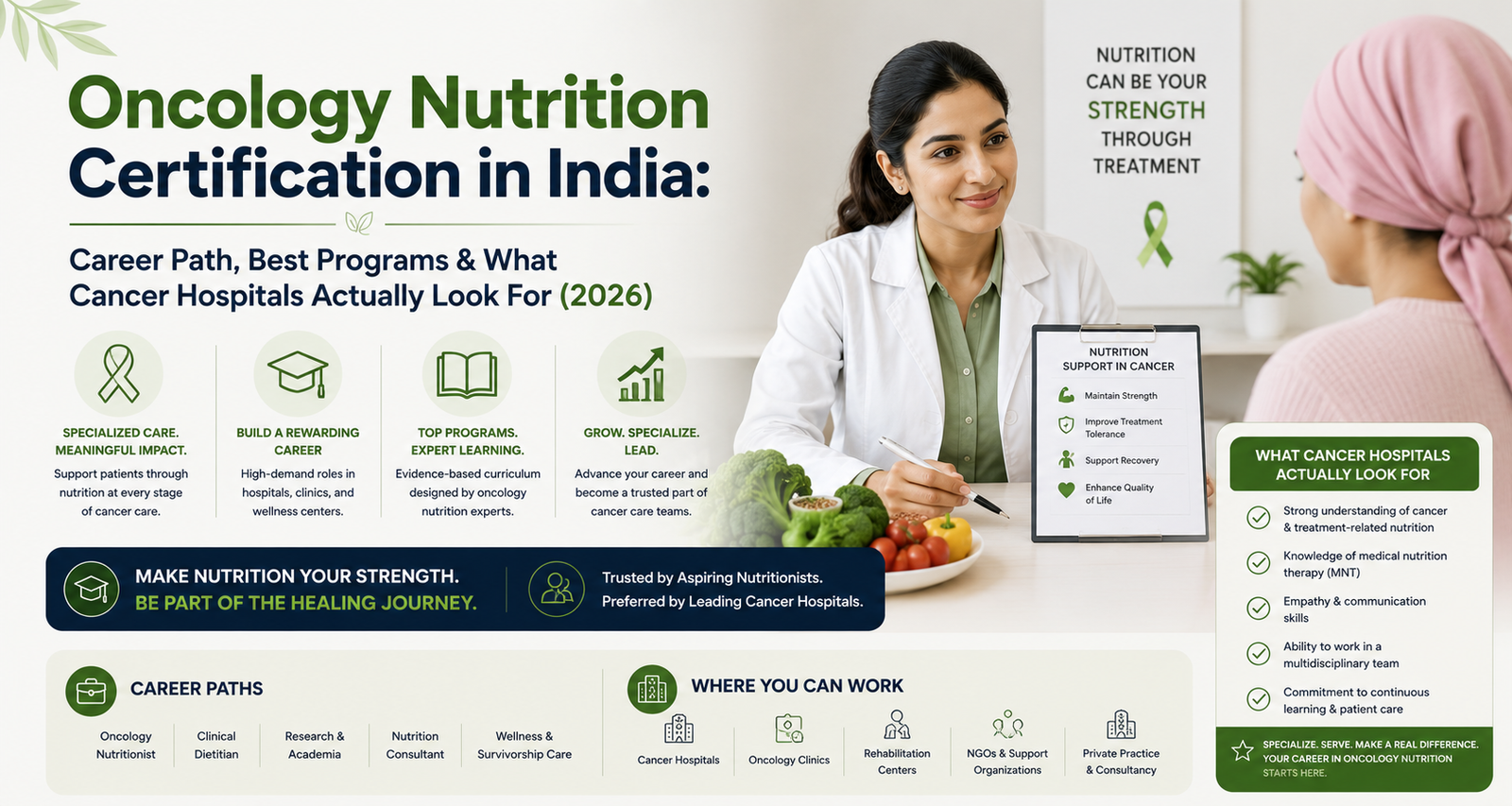
What Cancer Hospitals in India Actually Look For
This is the question nobody answers in any oncology nutrition guide — and it is the most practically useful one.
Based on conversations with oncology dietitians currently working in Indian cancer centres, and on published job descriptions from major Indian cancer hospitals, here is what they evaluate:
1. Clinical dietetic credential (degree or credible diploma): Most large cancer hospitals — Tata Memorial, AIIMS, Apollo Cancer Centres — list a degree (B.Sc. or M.Sc. in Dietetics, Food Science, or Home Science) in their job descriptions. A specialist oncology certification without a foundational degree is typically not sufficient for hospital employment on its own.
2. Oncology nutrition certification as a differentiator: Where two candidates have equivalent base credentials, an oncology nutrition certification from a recognised program is a significant differentiator. It signals intent and specialist knowledge. Medvarsity/Apollo’s CPD-accredited program is particularly valued by hospital HR in this context.
3. PG-SGA competence: The ability to conduct a proper nutritional assessment using the PG-SGA tool is often tested in interviews. If you cannot do this, a certificate alone will not compensate.
4. MDT communication skills: Oncology dietitians work with oncologists, surgeons, nurses, and palliative care teams. The ability to communicate clinical nutrition findings concisely in MDT rounds is evaluated — sometimes through a case presentation in the interview.
5. NGO and cancer support organisation path: If hospital employment is not your primary goal, cancer support NGOs (like CanSupport, Cancer Patients Aid Association) and palliative care organisations hire nutritionists for community-based patient support. Requirements are generally more flexible than hospital roles.
6. Private practice / referral network: Some oncology nutritionists build independent practices by developing referral relationships with oncologists at private hospitals. This takes time (1–3 years minimum), requires a strong clinical credential, and is genuinely viable in metro cities.
Is Specialist Certification Better Than a General Nutrition Diploma?
This is a question prospective students often ask when choosing between a diploma program and an oncology certification.
The short answer: you generally need both, in sequence.
A general diploma in nutrition and dietetics gives you the foundational clinical skills — assessment, MNT, counselling — that apply across all conditions. An oncology nutrition certification builds specialist knowledge on top of that foundation.
Starting with an oncology certification before completing a foundational diploma is possible but suboptimal — you will lack the clinical language, assessment skills, and disease-nutrition context that the specialist content assumes.
Recommended pathway:
- Complete a diploma in nutrition and dietetics (foundational clinical credential) → Diploma in Nutrition and Dietetics in India (2026 Guide)
- Gain hands-on supervised clinical practice → Nutrition Internship in India (2026 Guide)
- Add an oncology nutrition certification as a specialist layer
This sequence — diploma → internship → specialist certification — produces the most clinically capable and professionally credible oncology nutrition specialist.
Eligibility and Duration Summary
| Program | Minimum Eligibility | Duration |
|---|---|---|
| Nufit Redefined oncology cert | Diploma in nutrition and dietetics or equivalent | [See website] |
| Medvarsity (Apollo) | Open (designed for healthcare professionals; physicians, nurses, dietitians) | 3 months |
| IGMPI PG diploma | Graduate in relevant discipline | 6–24 months |
| NerdyGrad | Not specified on main page | Self-paced |
| IAPEN | Professional nutritionist background preferred | 6 months |
Frequently Asked Questions
Q: What is oncology nutrition certification?
Oncology nutrition certification is a specialist qualification that trains dietitians and nutritionists to provide clinical nutritional support to cancer patients across the treatment continuum — from diagnosis through active treatment (chemotherapy, radiation, surgery) to survivorship. It goes significantly beyond general nutrition training, covering cancer biology, tumour metabolism, treatment side effect management, and palliative care nutrition.
Q: Is there demand for oncology nutritionists in India?
Yes — and it is growing. India’s GLOBOCAN 2022 data shows 1.41 million new cancer cases annually, with projections rising past 1.57 million by 2025. Malnutrition in Indian cancer patients is prevalent and clinically significant. The trained oncology dietitian workforce is small relative to patient numbers. Major cancer centres in India consistently list dietitian positions, and the specialisation gap is real.
Q: What is the best oncology nutrition certification in India?
For healthcare professionals seeking CPD-accredited, institutionally recognised certification: Medvarsity (Apollo AHERF) offers BAC+ACCME accreditation and 10 CPD points at ₹5,000. For clinical nutritionists and dietitians seeking India-specific curriculum, mentor-led case work, and career-building guidance: Nufit Redefined’s program is designed for exactly this. For the strongest institutional credential combined with clinical depth: IGMPI’s PG diploma carries Ministry recognition, but curriculum access requires deeper investigation.
Q: Does an oncology nutrition certification qualify me to work in a cancer hospital in India?
Certification alone is typically not sufficient for hospital employment — most large cancer hospitals (Tata Memorial, AIIMS, Apollo) require a foundational B.Sc. or M.Sc. degree in dietetics, food science, or home science. A specialist certification is a significant differentiator alongside that degree. For NGO, community, and private practice paths, requirements are generally more flexible.
Q: What is the fee for oncology nutrition certification in India?
NerdyGrad: ₹2,800. Medvarsity (Apollo): ₹5,000. Nufit Redefined: [See website]. IGMPI and IAPEN fees are not clearly published on their main landing pages. The ₹2,800–₹5,000 range largely represents self-paced programs; mentor-led programs with case supervision are priced higher to reflect the instructor time involved.
Q: What is the difference between Nufit Redefined’s oncology course and the existing blog about oncology nutrition courses in India?
Nufit Redefined’s existing blog post at /blog/oncology-nutrition-courses-in-india/ provides an informational overview of oncology nutrition as a field. This post specifically addresses the certification pathway and career-building context — a different intent and a different audience. There is no content overlap between the two.
Q: How does cancer treatment affect nutrition needs?
Cancer treatment dramatically alters nutritional requirements through multiple mechanisms: chemotherapy causes nausea, vomiting, mucositis, taste changes, and immunosuppression (neutropenic diet may apply); radiation therapy causes site-specific damage (mucositis and dysphagia in head-neck, bowel damage in pelvic radiation); surgery creates pre- and post-operative nutrition requirements; cancer cachexia — a metabolic syndrome driven by inflammatory cytokines — produces progressive muscle wasting that standard high-calorie nutrition alone cannot reverse. Managing all of these requires specialist training.
Q: Do oncology nutritionists in India work only in hospitals?
No. Career paths include: hospital-based (oncology wards, cancer centres, palliative care units), NGO/community (cancer support organisations, palliative care outreach), private practice (1:1 with cancer patients referred by oncologists), corporate wellness (cancer screening and prevention programs), and education/content (evidence-based cancer nutrition content creation). Hospital-based roles typically require a degree; private practice and NGO paths are more accessible with a diploma + specialist certification.
References
- GLOBOCAN 2022 — India Cancer Incidence and Mortality Estimates (IARC, WHO)
- Indian Council of Medical Research (ICMR) — National Cancer Registry Programme
- National Institute of Nutrition (ICMR-NIN) — Dietary Guidelines for Indians
- Indian Association of Parenteral and Enteral Nutrition (IAPEN)
- Medvarsity — Certification Course in Oncology Nutrition